Showing posts with label Spartathlon. Show all posts

Thursday, 6 December 2012

Ancient Greek six-packs


I am learning a whole new series of skills as Connie and I take The Boy with Two Heads to schools and libraries as part of our constant market research and promotional activities. And I thought writing just involved writing!


artist's impression by Sian Frances
But we have been enjoying meeting my readers, and this week we met some Year 6 students at Egremont Library who impressed us a lot. Their teacher had already taken them through the first four chapters of the book, so we read a passage to them from further on which features Phidias' gold and ivory statue of Zeus. As I've mentioned elsewhere on this blog, the statue survived 800 years but was taken to Constantinople and destroyed in a great fire there. 

The students had also prepared some questions to ask me. I tried to answer these truthfully, but questions like 'where do you get your inspiration?' always stump me. I've thought about this since, and just want to say that I write because I enjoy it. I like going where it takes me in my head, getting to know my characters, and finding out what happens to them. It's a bit like reading, except that it takes longer, and I control the final outcome. 
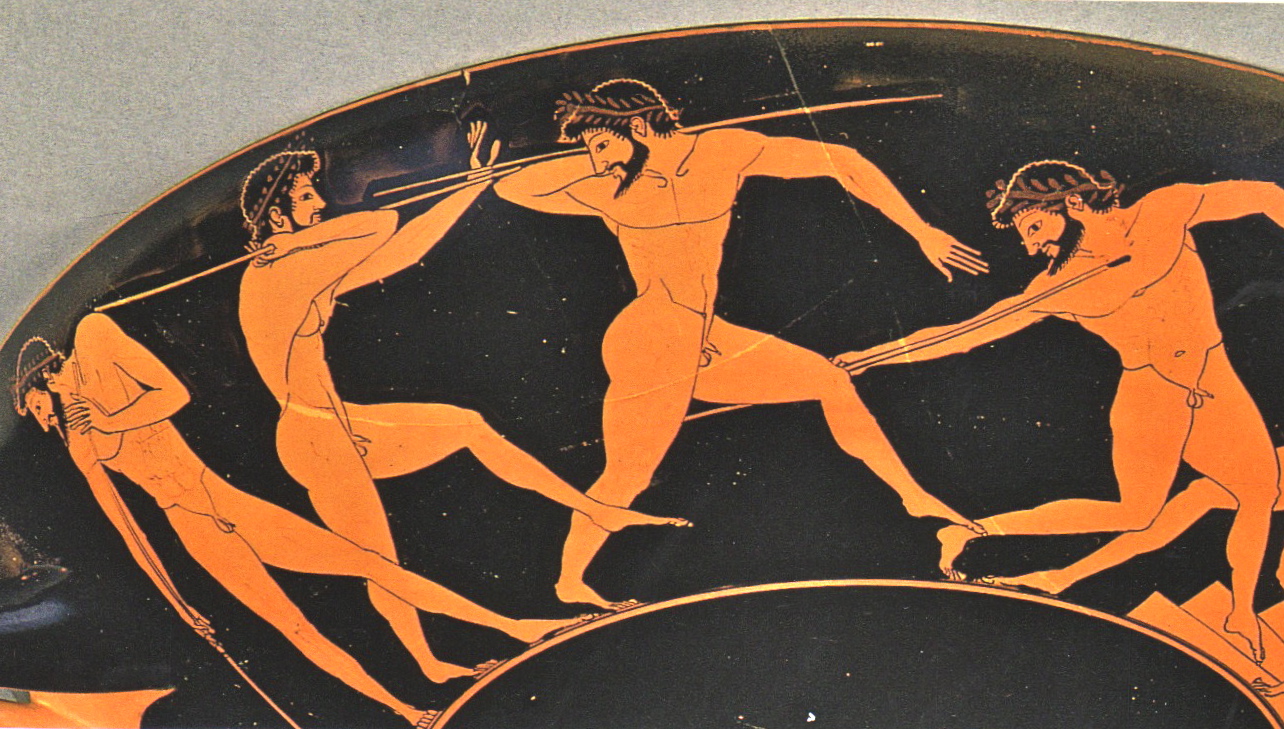

One unusual question we got this time was, 'Why did all the men have six-packs?' (This after looking at pictures of vase paintings and statues of naked men, as you do if you are discussing Ancient Greek athletes.) My answer was that the man's body was their best weapon in war, and they were always at war. They went into the army at 18 and were always eligible to be called up if necessary, which was just about every summer! So they spent a lot of time keeping fit. 
the Dioscouros
Roman copy of a Greek original

For many of them the Marathon would have been a short run. Professional messengers were expected to run at least 100 kilometres in 24 hours. There's a modern race called the Spartathlon which covers 246 kilometres (153 miles) in less than 36 hours, as reportedly run by Pheidippides in 490 BC. I refer to it in my posting on March 8th.

And as Connie noted, another factor was their diet - lots of unprocessed cereals, fruit, vegetables, cheese and olives, with the occasional fish, duck or hare, and beef only on feast days. 


the quintessential six-pack:
Apollo from the Temple of Zeus 
at Ancient Olympia
modern statue of
King Leonidas of Sparta
However, it is probably true that the statues were idealised. So maybe not all Ancient Greek men had six-packs. They must have been pretty common, though, because the body-armour seems to have allowed for them, as you can see on this modern statue in Sparta.


Lastly, I would like to correct something else that came up. Connie mentioned that the word for a publisher's logo is colophon (her company's colophon is a trefoil, or clover leaf). My suggestion was that colophon derives from the Greek words kollos for bottom (which is in fact modern slang), and phoni, meaning voice (as in telephone). This led to a certain amount of hilarity ... and is of course nonsense! 
According to Liddell and Scott's Greek-English Lexicon and Wikipedia, kolophon is an Ancient Greek word (though still in use) which means ‘the summit, peak, or finishing touch’. Comparatively boring, but true, nonetheless. My apologies to anyone I may have misled.

And my thanks to our audience at Egremont. You had done a lot of preparation for our meeting, and that made it extra special.


Thursday, 8 March 2012

Two Robins at Words by the Water

We were at Words by the Water again today. I spent the morning in the car on the phone with Connie finalising a Press Release. Yesterday the photographer from the Cumberland and Westmorland Herald, Fred Wilson, nobbled me near the bookshop and took some photos of Brian and me and The Boy with Two Heads down by the lake. So we wanted to provide some copy in case one of them is used in this week's paper.

Derwent Water near the Theatre by the Lake 
Then I walked along into the wood by the lake. I met walkers and dogs and, to my amazement, a robin. It flew onto a twig at my eye level about two metres in front of me. It sat there and cocked its head at me and chattered musically. We must have 'conversed' for two or three minutes. No one disturbed us and we discussed the weather, and the lack of berries, and cheese on birdtables, and my excitement about The Boy. In the end, I bid the robin good afternoon and moved off with care. S/he flew a tree or two further on and perched again, watching me.

I took the path through the gate onto the shore and enjoyed the damp but cobweb-shredding breeze. This photo is from a few years ago, but the time of year and the lighting are similar.

On Monday I went to a talk by a human Robin, Robin Harvie. He has written a book called Why We Run. I was interested in this question as my Boy with Two Heads does a lot of running. And it turned out that Robin Harvie has been a participant in the Spartathlon! I was living in Athens when this race was set up in the 1980s, and people I knew were involved in the organisation.

Spartan king Leonidas I, died 490BC
at Thermopylae
(photo from Wikipedia)
For those who haven't heard of it, the Spartathlon is a foot race from Athens to Sparta, in emulation of Pheidipiddes in 490 BC. It is approximately 150 miles and includes two mountain ranges, at least one of which is crossed during the night. Pheidipiddes arrived in Sparta the day after he left Athens, according to Herodotos, so the modern race has to be completed in that time frame, contestants arriving at the foot of the statue of Leonidas of Sparta.


I was enthralled and enchanted by Robin's talk, partly because I met some of the runners one year and was, and still am, completely in awe of their achievements. Also he is a good speaker, though not as tuneful as the robin I met this morning.