Showing posts with label nakedness in Ancient Greece. Show all posts

Friday, 8 February 2013

Ancient naked statues - modern dressed lambs

I know, I know. It's been nearly three weeks since I posted anything. But a writer's work is never done!!

And I've been working hard. I have strict deadlines on the third draft of my new story for Cambridge University Press, and putting together my page at ContactAnAuthor, and preparing a school talk, and getting ready to chair four sessions at Words by the Water Literary Festival in Keswick. (How did I get myself into this?)

And I wouldn't be blogging now, but I couldn't resist answering a question I was asked the other day. It was about the statue we used on the cover of The Boy with Two Heads. The question was: 'Have all the statues had their heads broken off?' That gave me an excuse to find some photos of him - and other such appealing creatures. (Most of them did have their heads broken off when they were found, but they've been mended now.)
the Youth of Antikythera
from the Wikipedia article

The head of The Boy stars in my posting on February 5th, 2012 (almost exactly a year ago – how odd…), but there I only show his face. As you can see, his body is too muscular for my 13 year old hero.

I give two links there to a lot more information about the statue, including:
He stands nearly two metres tall (not counting the plinth) in the National Archaeological Museum in Athens. He is known as the Youth of Antikythera, as he was found just off the island of Antikythera, in pieces on the sea-bed, in 1900. Because of the other things from a shipwreck found nearby, archaeologists say he came from the west coast of what is now Turkey and was probably made in 340 BC or so. 
[On his Wikipedia page, where this picture can be found, he is called the Antikythera Ephebe. The word ephebe is still used in modern Greek to mean a teenage man or youth (now pronounced 'ephivos' – the v in Greek looks like a b in Latin-based alphabets, so that is how it is often said by non-Greek speakers).]

The Youth is one of many similar statues that were made from about 450 BC in a pose still popular today. They were more lifelike than the previous, archaic naked males (reminiscent of Egyptian kings), and always had their weight on one leg. 

Hermes and Dionysus
Praxiteles' Hermes in Olympia
This marble statue is the Hermes of Praxiteles (the sculptor), honoured with his own room in the museum at Ancient Olympia. He was also made in the 4th century BC (although this may be a copy made around 325 BC), and is holding the infant Dionysus. He is very similar to the bronze Youth, and was found in Olympia, where much of The Boy with Two Heads takes place. The Hermes is mentioned as being at Olympia by Pausanias in the 2nd century AD. The fact that he was found, as described by Pausanias but under a thick layer of river clay 1,800 years later, is the kind of thing that makes the hair on my arms stand up. 

the original David,
from the Khanacademy webpage
Michelangelo's David (1504 AD) follows the same artistic tradition. On this website you can see a replica of the David where the original was once placed (it is now in the Galleria dell'Accademia). There is a vertiginous 360 degree facility to look at the whole Piazza della Signoria in Florence. 

But no mention is made in the text of David's Greek forebears among the ranks of naked male statues.


Enough of that ...

I downed tools this afternoon and went for a walk in the sun, and look what I found in the field! Instead of creatures usually-clothed-but-naked-for-the-sake-of-art, I saw creatures that are usually-naked (well, sort of) but-clothed-for-the-sake-of-warmth ... in plastic coats. 

Somehow that took the edge off the excitement of seeing my first lambs this year. 


Back to work!


Thursday, 6 December 2012

Ancient Greek six-packs


I am learning a whole new series of skills as Connie and I take The Boy with Two Heads to schools and libraries as part of our constant market research and promotional activities. And I thought writing just involved writing!


artist's impression by Sian Frances
But we have been enjoying meeting my readers, and this week we met some Year 6 students at Egremont Library who impressed us a lot. Their teacher had already taken them through the first four chapters of the book, so we read a passage to them from further on which features Phidias' gold and ivory statue of Zeus. As I've mentioned elsewhere on this blog, the statue survived 800 years but was taken to Constantinople and destroyed in a great fire there. 

The students had also prepared some questions to ask me. I tried to answer these truthfully, but questions like 'where do you get your inspiration?' always stump me. I've thought about this since, and just want to say that I write because I enjoy it. I like going where it takes me in my head, getting to know my characters, and finding out what happens to them. It's a bit like reading, except that it takes longer, and I control the final outcome. 


One unusual question we got this time was, 'Why did all the men have six-packs?' (This after looking at pictures of vase paintings and statues of naked men, as you do if you are discussing Ancient Greek athletes.) My answer was that the man's body was their best weapon in war, and they were always at war. They went into the army at 18 and were always eligible to be called up if necessary, which was just about every summer! So they spent a lot of time keeping fit. 
the Dioscouros
Roman copy of a Greek original

For many of them the Marathon would have been a short run. Professional messengers were expected to run at least 100 kilometres in 24 hours. There's a modern race called the Spartathlon which covers 246 kilometres (153 miles) in less than 36 hours, as reportedly run by Pheidippides in 490 BC. I refer to it in my posting on March 8th.

And as Connie noted, another factor was their diet - lots of unprocessed cereals, fruit, vegetables, cheese and olives, with the occasional fish, duck or hare, and beef only on feast days. 


the quintessential six-pack:
Apollo from the Temple of Zeus 
at Ancient Olympia
modern statue of
King Leonidas of Sparta
However, it is probably true that the statues were idealised. So maybe not all Ancient Greek men had six-packs. They must have been pretty common, though, because the body-armour seems to have allowed for them, as you can see on this modern statue in Sparta.


Lastly, I would like to correct something else that came up. Connie mentioned that the word for a publisher's logo is colophon (her company's colophon is a trefoil, or clover leaf). My suggestion was that colophon derives from the Greek words kollos for bottom (which is in fact modern slang), and phoni, meaning voice (as in telephone). This led to a certain amount of hilarity ... and is of course nonsense! 
According to Liddell and Scott's Greek-English Lexicon and Wikipedia, kolophon is an Ancient Greek word (though still in use) which means ‘the summit, peak, or finishing touch’. Comparatively boring, but true, nonetheless. My apologies to anyone I may have misled.

And my thanks to our audience at Egremont. You had done a lot of preparation for our meeting, and that made it extra special.


Tuesday, 13 November 2012

Nakedness (of men) in Ancient Greece


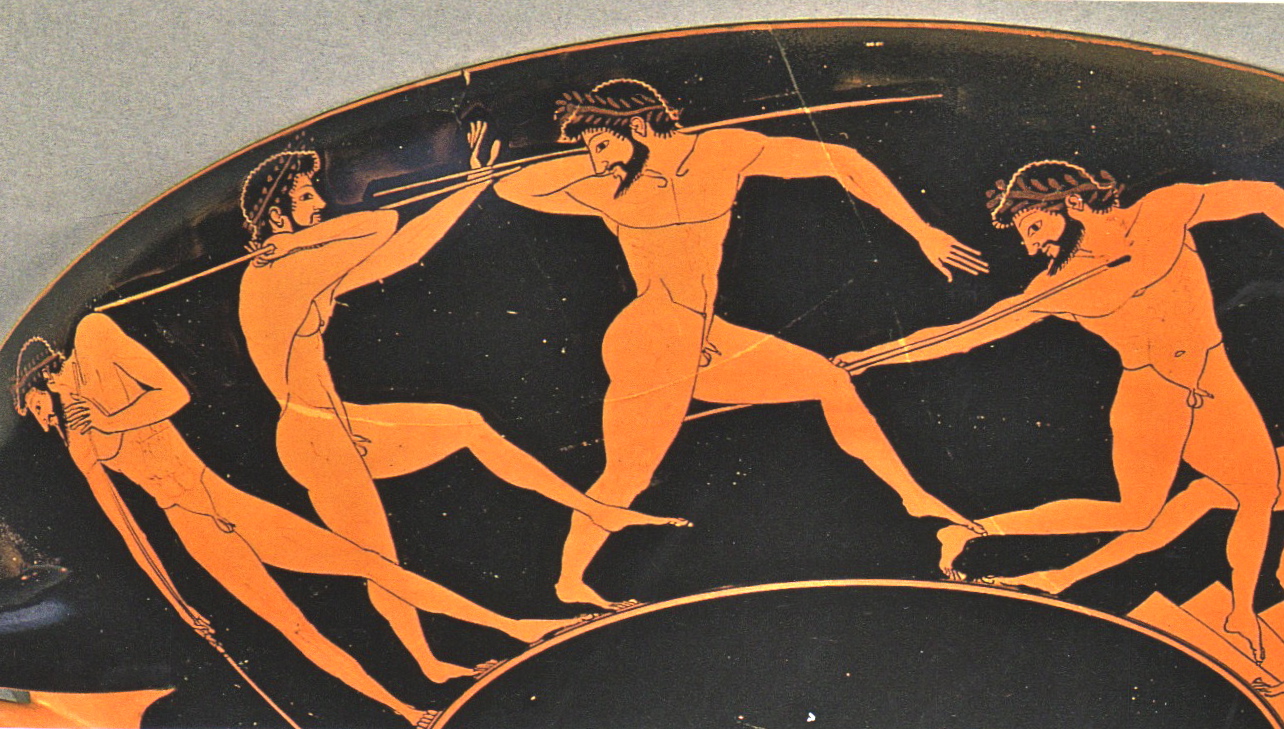
At a reading of The Boy with Two Heads yesterday, in Wigton Library, I showed pictures of vase paintings of (male) naked athletes. 

These three boys of differing body types are at an Athenian gymnasium where middle and upper class men and boys trained almost every day. The word 'gymnasium' comes from the Greek for naked, gymnos (spelled gamma, ipsilon, mi, ni, omicron, sigma - there are no Greek fonts for this blog!) 

My audience of year 6 students asked, "Why were they naked?" If I remember correctly, my answer was along the lines that 
1)  it was only the men and boys, and they did not see why not
2)  the weather was often hot
3)  they had no problem showing off their physical beauty. 

Concerning point 1, I think they did not see "why not" because their religion did not suggest they should cover their bodies. The Christian Bible was written many centuries later. Genesis chapter 3 vividly describes how Adam and Eve ate from the tree of knowledge and realised they were naked. They made aprons of fig leaves to cover themselves, but God ejected them from the Garden of Eden anyway. For Christians this has resulted in a belief through the centuries that we need to be ashamed of the parts of our bodies to do with reproduction. I don't know the Q'ran or other religions' bibles, but perhaps there are similar stories. In Ancient Greece (and some other religions, even now), such parts of the body were often seen as the sacred means of continuing the family and the tribe. There was no shame or guilt attached to them.

Concerning point 2, the weather in Greece, especially in July and August when athletics competitions were mainly held, can be very hot (at least 35 degrees C in the shade). So any clothes can feel unnecessary.
Men's 'chiton' or robe

Ionian Women's 'chiton'
And Ancient Greek clothes were mainly just pieces of cloth attached to the body by belts and/or brooches. This made them impractical when it came to sport. There's a story in Pausanias (I think, or it might be Homer. I can't find it again, of course!) that in the very early days, the runners wore loincloths. During one race, one runner's loincloth came off as he ran and he won! So it became the norm for athletes to train and compete without any clothes at all to impede them.


the Discobolos of Myron
This leads into point 3 above. Being naked was a way of showing off an athlete's perfect physique. The body-perfect was a theme for aspiration, discussion and artistic debate even more then, it seems, than it is now! Larissa Bonfante has written about 'nudity as a costume' in classical times.

So in the right circumstances, nakedness could be not only acceptable but desirable. However, on this blustery, damp day in early winter in northern England, those circumstances seem a long way away and a long time ago!