Showing posts with label Trifolium Books UK. Show all posts

Sunday, 26 January 2014

Just one head ... on the loose in London


Dear Reader,

Today has been wonderful for this writer on the loose!

Inside the Guardian!
I spent the morning and afternoon at seminars about blogging (twitter #bloglikeapro) in the Guardian building near Kings Cross. I learned a whole raft of ways in which your experience of my blog can be made more pleasant and useful. You will see some (gradual) changes as the months go by and I learn how to put them into practice. I also talked to other interested writers about The Boy with Two Heads and Trifolium Books. And I handed out some flyers. This always feels good!


Once the seminars finished, I set off into London via Kings Cross Station - my first visit since it was renovated. How could I resist taking photos?


And I found Platform Nine and Three-Quarters ...  It has a shop, too. I hadn't realised it was a permanent fixture.


Later, over a Greek meal near Regents Park, I read part of Louis de Bernieres' ImaginingAlexandria. ‘To the Scandal of Poets’ made me laugh out loud (which disconcerted the Greek waiter – older woman on her own enjoying herself?) and ‘The Man who Travelled the World’ made me want to cry. De Bernieres says his poems are a tribute to the Alexandrian Greek poet, C P Cavafy, but they have other dimensions, too.

On the way home I once again enjoyed the view of the London Eye from Charing Cross. 

So for me this day had all the elements of the perfect writer's day – lots of research, other writers for company, beautiful things to see and be inspired by, good food for stomach and mind, and a glass of good wine.

Just one thing: I didn't write anything!

But I have re-organised the blog a bit. Please let me know what you think – addresses below.


Oxford Street at sunset, Dec 31st 2013
P. S.
Sorry if my title led you to expect tales of debauchery and forbidden pleasures (and/or shopping?). You might find more excitement (though I doubt debauchery) on the Time Out in London blog run by our midday speaker today, Sonya Barber. The whole city is there!


You can contact me via:
Comment on this blog
@JuliaMNewsome on Twitter
'J M Newsome, author' on Facebook

All photos my own (sorry about the Platform Nine and Three-Quarters quality) except the cover of Imagining Alexandria, which is from Amazon's relevant page.


Friday, 20 September 2013

Is the guitar descended from the Ancient Greek kithara?


In my novel, The Boy with Two Heads, the hero, Themis, travels to
Olympia around the Peloponnese in a small cargo ship with his uncle Panainos and his personal slave, Frog. There is one other passenger, Molon. Journeys like this (see Map 2) were usually made by sailing during the day and camping on land at night. On the second evening of the four-day voyage, they sit round the camp fire as night comes down and the captain tells them a story. (Story-telling was, of course, a highly valued skill at the time.) Themis comes to sit by the fire ...

   ‘Arion overheard the sailors,’ Captain Stomio was saying. They had just broken into his travel trunk and found his hoard of gold. They were deciding when to throw him overboard.’ 
   ‘Not a good advertisement for your colleagues, dear Captain,’ said Panainos, one eyebrow raised.
   ‘They were Corinthians,’ said the captain. ‘What d’you expect?’ 
   Molon looked shocked, but Panainos and Frog laughed.
The captain went on. ‘Arion was a famous musician and had become rich from his profession. But there was little he could do. He offered to give them all his gold if they would spare his life. But the sailors just jeered at him. So he dressed himself in his richest performance robes and, standing on the bow of the ship, he played his best kithara and sang his favourite song as an offering to Poseidon.
   ‘The sailors enjoyed the song, but showed no mercy. So, rather than let them stab him with their daggers, Arion leapt off the ship into the sea, kithara and all.’
 
professional singer, ?450BC
   Captain Stomio stood up to kick the fire and drink some water. ‘Dolphins like music,’ he said, as he sat down again. ‘The ship sailed away, but a group of dolphins had gathered to listen to Arion’s song. They carried him with them on their backs for two or three days. They chattered and clicked at him to show they wanted him to play for them, and so he did, all the time hoping they would take him nearer to land. At last they understood he needed food and fresh water, and they brought him in to the west port at Tainaron still wearing his magnificent costume and carrying his kithara. He stood on the end of the quay and gave them one last song. Then, when he’d drunk and eaten, he set off for Corinth to find and punish his would-be murderers!’ 
   ‘And did he get his gold back?’ asked Panainos. 
silver two drachma coin, about 300 BC
   ‘Who knows?’ answered the captain. ‘But he may have, because he had a bronze statue of a man on a dolphin cast, and set it on the quay-side in Tainaron as a thank offering.’


Christina Katseli plays Cretan lyre, Angelos Kyriakos plays Steriano lute,
and Dimitris Zaharis plays bendir (hand drum)

I was reminded of the above story while on a flying trip to Athens last week. During a catch-up session with old friends, we remembered a wonderful musical evening we spent in the depths of winter in the cozy basement of a taverna, listening to traditional songs played on instruments which seemed to have changed little in thousands of years. 


There is an ongoing and intriguing academic argument about the origins of stringed musical instruments. One Greek myth records that the first stringed musical instrument with a soundbox was made by Apollo from the shell of a tortoise, with strings of cow hide stretched over a frame made from the cow's horns. The hypothesis goes that this original instrument (very similar to even older depictions of stringed instruments in the Middle East and perhaps elsewhere) evolved in two different directions: one was the modern guitar and the other was lyres and lutes. The kithara as illustrated in the 5th century BC is neither of these. The main reason to believe that the modern guitar evolved from a kithara like Arion's seems to be the similarity in the name ...

Anyway, the instruments we listened to back in January on that Epiphany evening seemed to me to be almost the same as their ancient counterparts - but what do I know? The drum, at least, has changed not at all, though our modern musician was wearing a few more clothes than this ecstatic player ...

Whatever their origin, the instruments and music took us back to the days of bards singing while audiences ate and drank and joined in the choruses ... Christina and friends represent the many who still love and practice music played on lyres - it is very much alive and well, so we can still guess what Arion sounded like to his audience of dolphins.


The Boy with Two Heads is published by Trifolium Books UK, and is available from all good bookshops and on Amazon both as a traditional paperback and as an e-book.


Wednesday, 3 July 2013

How many lions in Olympia?


SPECIAL ANNOUNCEMENT!
Before I begin on the lions, I just want to mention that Trifolium Books is offering The Boy with Two Heads e-book for a limited time at the incredible price of £1.02, via my Trifolium Books author page. Go to Trifolium Books in the menu bar, and Authors in the drop down list, then The Boy with Two Heads. Click on the right hand of the two icons of the book.

This is a special promotion of all Trifolium Books to celebrate the imminent re-publication of The Bride of the Spear by Kathleen Herbert. Thank you, Connie, for including me in your celebrations! And congratulations on your guest posting on Helen Hollick's blog.


But to go back to the lions, every time I go to the Archaeological Museum at Olympia, I am enchanted by something new. This time I came across this little creature ...

Dating from (I think) about 700 BC, he must have been a knob or handle on a bronze vessel. I thought he was charming, and set off on a lion hunt through the museum to find more.

And they were everywhere: 


underfoot (from the pediment of the Temple), ...


... on the gutters, ...
 ... on the rims of cauldrons, ...
 ... as parts of statues, ...


... handles, ...
... religious offerings, ...


... and even as warnings. 


They reminded me of the importance of lions at Mycenae, where the remains of the palace date from about 1400 BC. 
The Lion Gate entrance to Mycenae.
from the cover of the official guidebook
to Mycenae
I have often wondered whether these Mycenean lions ever had heads and, if so, how they fitted into the triangular space ... But at least there were heads on some of their lions, like this glorious gold one, now in the National Archaeological Museum of Athens ...


... and these tiny but perfect lions on the blades of Mycenean daggers which are there, too.
from the official guidebook to Mycenae


As I said in my last posting, in ancient times, there must have been all kinds of dangers that today we cannot even imagine. From the number of representations of lions, they were one of those dangers. Herakles (Hercules) of the Twelve Labours was central to the myths of heroes, and his first Labour was to kill the Nemean Lion. 

It seems likely that lions were still roaming the forests of Greece in Alexander the Great's time (356 to 323 BC) as the illustration on his father, Philip II's tomb at Vergina suggests. This is a reconstruction of the frieze above the doors of the tomb. The man on the horse in the middle is assumed to be Alexander. The boar at the feet of his horse has been dispatched and he turns his attention to the (strangely red) lion being harried on the right. 
Artist's reconstruction of the frieze over the door of Philip of Macedon's tomb
from 'Vergina', published by Ammos Editions, Athens.

My hero, Themis, does not meet a lion in The Boy with Two Heads. But he does meet a bear on a mountain top, and bears, though endangered, still live in the forests of northern Greece.

I read somewhere that lions were extinct in Greece by about 100 BC. Still, it was obviously a feat of great bravery to kill one while they were still a threat. Even today (although killing a lion is against the law in all but exceptional cases) the Maasai warriors of East Africa still gain glory and status if they take part in such an exercise. I must say, it's not quite my idea of a restful Sunday afternoon pastime ...


Friday, 1 March 2013

The Boy's 1st anniversary

 Youth of Antikythera
It is one year today since The Boy with Two Heads was published. 

Connie Jensen of Trifolium Books and I liked the idea of launching The Boy on the world on February 29th. And as there isn't a February 29th this year, we're celebrating today, March 1st.

Which highlights an age old problem of measuring time and using calendars - and a tenuous connection between two ancient artefacts and The Boy. 

As I have mentioned in this blog before, in 1900 a wreck was found by sponge divers on the sea bed off the island of Antikythera to the south of the Peloponnese on the main route from Ancient Ionia (present day Turkey) to Rome. Among the many artefacts discovered were the pieces of the statue that is now the Youth of Antikythera (we used his face on the cover of The Boy with Two Heads) and a mysterious 'mechanism' in a wooden box. 
Antikythera Mechanism from Wikipedia


It is thought that the purpose of this device was to predict lunar and solar eclipses based on Babylonian arithmetic-progression cycles. The inscriptions on the device also support suggestions of mechanical display of planetary positions.*
There is a long and detailed article about the Antikythera Mechanism on Wikipedia (from which this quote comes). And on Tuesday 12th February 2013 on BBC4 there was a fascinating documentary about it called The Two-thousand-year-old Computer. This is sadly not available on BBC iPlayer, but there's an older, more emotive, 50 minute film about it on You Tube.

The ship was probably wrecked in about 70 BC and the mechanism is thought to have been made around 100 BC. From its complexity, it seems unlikely that it was a prototype and may have been the result of hundreds of years of engineering skill.

So it seems (accidentally) fitting to me that my Boy with Two Heads has his 'anniversary' on February 29th, a day added to our calendar to correct it in relation to the movement of the astronomical bodies that the Mechanism was made to predict. And both the statue we used to represent him and the Mechanism were found in the same shipwreck.


Perhaps that's labouring it a bit, but I love to find patterns in this messy and magnificent chaos we call life ...

... which is one of the themes in The Boy with Two Heads.


*M. G. Edmunds, et al. “Decoding The Ancient Greek Astronomical Calculator Known As The Antikythera Mechanism.” Nature 444.7119: 587-591. Academic Search Complete. Web. 15 Nov 2012.


Thursday, 6 December 2012

Ancient Greek six-packs


I am learning a whole new series of skills as Connie and I take The Boy with Two Heads to schools and libraries as part of our constant market research and promotional activities. And I thought writing just involved writing!


artist's impression by Sian Frances
But we have been enjoying meeting my readers, and this week we met some Year 6 students at Egremont Library who impressed us a lot. Their teacher had already taken them through the first four chapters of the book, so we read a passage to them from further on which features Phidias' gold and ivory statue of Zeus. As I've mentioned elsewhere on this blog, the statue survived 800 years but was taken to Constantinople and destroyed in a great fire there. 

The students had also prepared some questions to ask me. I tried to answer these truthfully, but questions like 'where do you get your inspiration?' always stump me. I've thought about this since, and just want to say that I write because I enjoy it. I like going where it takes me in my head, getting to know my characters, and finding out what happens to them. It's a bit like reading, except that it takes longer, and I control the final outcome. 


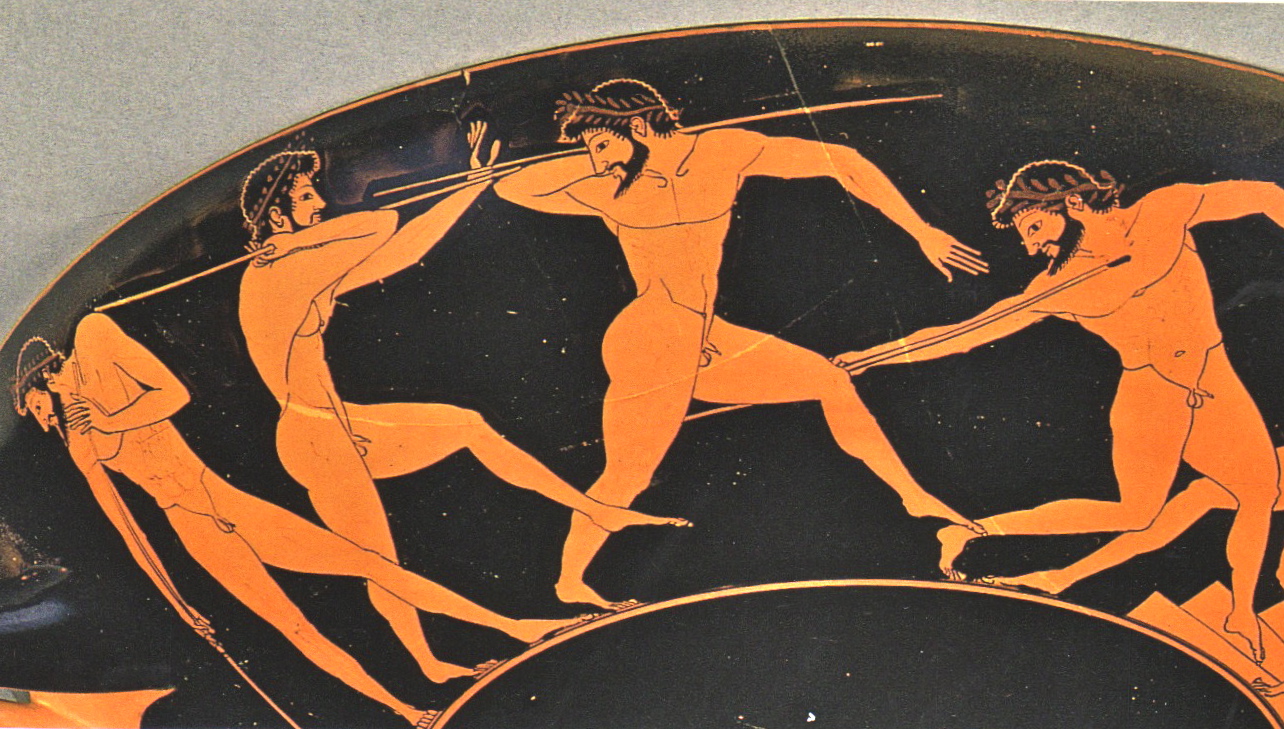
One unusual question we got this time was, 'Why did all the men have six-packs?' (This after looking at pictures of vase paintings and statues of naked men, as you do if you are discussing Ancient Greek athletes.) My answer was that the man's body was their best weapon in war, and they were always at war. They went into the army at 18 and were always eligible to be called up if necessary, which was just about every summer! So they spent a lot of time keeping fit. 
the Dioscouros
Roman copy of a Greek original

For many of them the Marathon would have been a short run. Professional messengers were expected to run at least 100 kilometres in 24 hours. There's a modern race called the Spartathlon which covers 246 kilometres (153 miles) in less than 36 hours, as reportedly run by Pheidippides in 490 BC. I refer to it in my posting on March 8th.

And as Connie noted, another factor was their diet - lots of unprocessed cereals, fruit, vegetables, cheese and olives, with the occasional fish, duck or hare, and beef only on feast days. 


the quintessential six-pack:
Apollo from the Temple of Zeus 
at Ancient Olympia
modern statue of
King Leonidas of Sparta
However, it is probably true that the statues were idealised. So maybe not all Ancient Greek men had six-packs. They must have been pretty common, though, because the body-armour seems to have allowed for them, as you can see on this modern statue in Sparta.


Lastly, I would like to correct something else that came up. Connie mentioned that the word for a publisher's logo is colophon (her company's colophon is a trefoil, or clover leaf). My suggestion was that colophon derives from the Greek words kollos for bottom (which is in fact modern slang), and phoni, meaning voice (as in telephone). This led to a certain amount of hilarity ... and is of course nonsense! 
According to Liddell and Scott's Greek-English Lexicon and Wikipedia, kolophon is an Ancient Greek word (though still in use) which means ‘the summit, peak, or finishing touch’. Comparatively boring, but true, nonetheless. My apologies to anyone I may have misled.

And my thanks to our audience at Egremont. You had done a lot of preparation for our meeting, and that made it extra special.